Thursday, November 21, 2013

Mentzer Basic Cover to Cover: Dice

There they are, those beautiful polyhedra we all know and love.  Notice that the non-Platonic solid d10 is not pictured.

Anyway, our next section in the Mentzer Basic Players' Book is a half page on dice.  It's written for a complete beginner.  It starts by explaining that dice is the plural of die.  That beginner.

Well, as I've mentioned before, it was written for, in modern parlance, complete noobs. 

Anyway, we get a description of each die, a bit of advice on how to roll and read the d4 in particular, how to get a d% by rolling the d10 twice, and how to get other dice combinations.

Dice notations are also explained.  This section also mentions how to calculate non-die ranges, such as d2, d3, and d5.

With the advent of the OSR, there's been a lot of discussion about this sort of "dice tutorial" appearing in game books.  Do we need it?  Can we leave it out?  What if someone picks up a retro-clone as their first RPG?  Do only experienced gamers tend to collect these modern, typically self-published offerings?  Are we somehow neglecting to grow the base with the next generation if we leave this sort of thing out?

Looking at my own offering, Flying Swordsmen, you can see that I split the difference.  I didn't include this sort of thing in the book itself, but there's a note directing readers to my blog, where I did write up my own little dice tutorial and "what is role playing?" bits for someone who happens to stumble across Flying Swordsmen without having ever played another RPG that uses polyhedral dice, and without someone more experienced to show them the ropes.  In the internet age, that seemed to be the best course for me and my publication.

But back in '83, when this set was being produced with the express purpose of getting it out onto mainstream retail outlets and into the hands of kids and adults who were not already part of the gaming scene, this sort of thing was absolutely necessary.

So I don't knock this section any points.  In fact, I give it full points for not leaving anything to chance - right down to the initial explanation of die/dice. 


Monday, November 18, 2013

Mentzer Basic Cover to Cover: Your Character

The next three and a half pages of the Mentzer Basic Set's Players Book continue the tutorial, going over the character sheet and what everything on it means.  It repeats a bit of ground, going over your ability scores, hit points, and a few other things that the "Your First Adventure" section covered, and pretty much everything else that's on the character sheet.  A lot of the basics of play are covered here.

Again, it is written at a low reading level.  It was designed to introduce the concepts of RPGs in general and D&D in particular to kids who didn't have someone around to teach them.  It succeeded, but yet there were still areas in this section that I didn't get right for the first few years we played.  I guess I (like most 11 year old kids I suppose) didn't bother to go back and re-read sections I wasn't clear on, even though Frank explicitly told us to do so in bold print even. 

But then isn't that what the spirit of D&D is all about anyway?  Take what you don't understand and ignore it or make something up to fill the gap?  So we completely ignored the Constitution stat for a while (unhealthy adventurers?  Didn't make sense), rolled a straight d20 for abilities instead of 3d6 (rerolling 1s and 2s since we picked up on the minimum 3 score, but ignored the maximum 18 - and yes, my Fighter Gwydion did have a 20 Strength, thank you very much!  Our characters were the Spinal Tap amps of D&D.), and a few other things.

Getting back to the book, the section starts off talking about Alignment.  Before anything else, it gives us the info that Lawful equals friendly and helpful, Chaotic equals selfish and nasty (carefully avoiding using "good" and "evil" as the BADD/Jack Chick crowd were now paying attention), and Neutral is in the middle, sometimes selfish sometimes selfless.

We get a very important piece of advice next, always use a pencil.  Things on the sheet will change.  This has stuck with me, and I have belittled players before for using a pen.

Frank goes over each section of the character sheet, but because it's following the character sheet format, it can be a bit disjointed.  The information doesn't quite gel for me, reading it now.  Granted, this is just a primer, and more detailed information follows later.  We get explanations of basic game values (AC, hit points, level, the ability scores in a bit more detail, saving throws, etc.).

And on the back of the sheet we get info on magic items, normal gear, money, and experience points.  Frank points out in this last section that there is more XP to be gained from treasure than from killing monsters.  Even in the sample adventure, where Bargle charms and sleeps you and steals most of the loot you gather, you still come back with 200 xp from treasure and only 30 xp from monsters slain.  There's also advice that avoiding, treating with, and tricking monsters to avoid fights and get treasure without combat should be preferred.  I wish this advice had been repeated elsewhere in the rules, as I didn't go back and re-read this section often, unlike later parts of the book.  Our early games did tend to be hack-and-slash affairs.  Big monsters like dragons tended to inspire us to cleverness, but most creatures were just attacked on sight.

Overall, there are some gems of gaming advice here, and the basics are covered, but it didn't stick in my memory as well as the parts that were taught by doing (or at least done by proxy) in the previous section.

Sunday, November 17, 2013

Two sohei walk into a haunted castle...

Last night we ran another play test of Chanbara.  Things are going well.  Dean and Alexei were the only two players available, and they are both playing sohei.  It made for an interesting experience, and helped us to find some fuzzy areas in the rules that need to be ironed out.
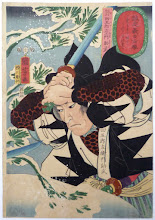
Little Sparrow the Sohei by Dean Flemming

Basically, I was going for OD&D levels of sparseness of spell and ability descriptions.  And we found out why the descriptions of such things have gotten longer and more legalistic over the decades first hand.  Now, I don't need to go to Pathfinder lengths to describe every little detail and proscribe every possible abusive case.  That last part is something individual GMs should be able to handle.  But I do need to be concise yet specific in the use of certain abilities.

I also need to think of some sort of caster limit.  Chainmail roll to cast mechanics are working well as a means of working spells in play, but while in a wargame there's a limit to the amount wizards will be casting determined by the length of the "battle," there's no such limit in RPG campaign play.

Some sort of limit needs to be in place.  Now to figure out what.  I don't want Vancian spells per day by level, nor a spell point system.  But possibly a hard limit on spells per day regardless of level?  Or fatigue such as the Stars Without Number system strain mechanic?  Something else?

One proto-idea floating around in my head would be a system of diminishing returns for casting the same spell more than once.  So a caster would be able to cast each spell they know once per day at no penalty, but each additional casting of each spell would be at a penalty, have a cost, or cause some sort of hindrance.  Having to track it for every spell, especially at high levels, would get tedious, I think.

At the moment, I'm leaning toward a modified SWN system strain mechanic.

Oh, and the two sohei, both designed for hunting undead, did really well in the castle versus skeletons and jikininki, but had a hard time in a random encounter against a group of kama-itachi (flying sickle weasels).  Probably as it should be.

Thursday, November 14, 2013

Mentzer Basic Cover to Cover: Your First Adventure

Pages 2 through 8 of the Mentzer Players Book contain the tutorial "adventure" that walks the nameless Fighter through some caves to encounter a few monsters, Aleena the Cleric, and the evil Bargle the Magic-User.

It gets slagged on a lot these days.  It's written for idiots!  It's a baby version of the game!  Blah blah blah.

Let me tell you something.  I'd read some Choose Your Own Adventure type books, some fantasy stuff like Lloyd Alexander's Prydain Chronicles, and of course watched plenty of Saturday morning Cartoons, including the D&D Cartoon before I got this set.  But even then, I still had no idea how to actually play the game.  And this section taught me, in an interesting way, quite a few tropes of D&D play that I wouldn't have gotten otherwise.

It teaches you how to make attack rolls and saving throws.  It explains the six ability scores.  It lets you know what the different classes are, what they are good at and why it's good to have a variety of classes in a party.  It teaches you a bit about a few monsters, and some basic dungeoneering advice, like lighting, listening at doors, what are the good treasures, etc.  And it'll break your heart when Bargle slaughters Aleena with his magic missile.

Yeah, looking at it today, as experienced gamers, it looks like 7 wasted pages in the book.  But it served its purpose well with me back in the day.  I didn't have anyone to teach me the game, I just had these books.  And despite making quite a few mistakes early on (which didn't really matter, we were having fun and it was the spirit of the rules more than the RAW that matters anyway), I got it and was able to teach my friends from this.

Now, more recent RPGs, like the Lamentations of the Flame Princess game, came with the learning to play tutorial in a separate booklet.  Actually, back in the day Star Frontiers also had a "basic play" 16 page booklet along with the 64 page main booklet.  It's a good idea.  But since they already had two booklets going in, I guess it made sense to have this in the Players' Book rather than have it and the CYOA-style adventure that comes next in a small booklet, the players' info in another small booklet, and the DM stuff in a bigger book.

Anyway, last word on this section is about the final section of the tutorial, "Winning."  Of course it tells you that there are no "win" conditions in an RPG, and that if you have fun, that's considered winning.  Even if you die.  You can always just roll up another character.  Still good advice, 30 years later.


Sunday, November 10, 2013

Ur-sine Adventures

After many many weeks (nearly many moons!), we finally got to play an adventure in Justin's Vaults of Ur campaign.

We'd left off in September with the arrest and confinement of Venerable Carolus (now leveled up and called Little Bear Carolly) and Maya the Elf, for the wanton slaughter of the Homesteaders.  Long story short, he was framed, man!

Well, the powers that be in Fort Low, being Lawful to a fault, don't allow humans to interfere with JUSTICE!  They use random chance to decide court cases.  And Carolly and Maya were sentenced to Trial by Anthropomorphic Spirit Journey.  We all got to come along!

Of course Dean was playing Carolly and Alexei was playing Maya.  Jeremy had Noctis the Orc, and since I'd said Thomas the Visionary (my backup 70's style pervy magic-user) was in Fort Low and willing to help out with Karl, I ran him instead of Thidrek.

After imbibing some potions, we entered the Dream Quest forest as Soldier Bears.  We had to readjust stats, using a variant of Pendragon stats where Strength became Gentle/Savage, with a 3 being a bonus for Gentle but penalty for Savage and 18 vice versa, and all the other 5 ability scores split into dual system as well.  As with the Hill Cantons monster stats, we each had 2d6+2 hit points (Swords and Wizardry).  [Justin is trying it out for a possible future Arthurian game using this setup.]

We actually started out in a home under the name of Sanders.  We grabbed pole arms (much discussion of Gygax's fascination with them, some posting of pictures followed), with Carolly taking a glaive-guisarme, Thomas taking a Bohemian ear spoon, Maya taking a bardiche, and Noctis taking IIRC a pole axe. 
Wandering in the forests, we were attacked by swine-men, trapped and escaped an ogre's clutches, and then confronted by My Little Pony unicorns and told that in addition to the ogre's pendant we'd need four more tokens to beat the accusers (our former henchmen), escape and prove Karl's innocence.

Saturday, November 9, 2013

Mentzer Basic: Cover to Cover

Do I have time to spend on a big long blogging project?  Not really, but if I keep it simple and my sections brief, I can try to get a post up every week or so without disrupting my academic readings and related writing.  Or at least I hope so.  We'll see.

My 40th birthday is coming up in about a month, so it was 29 years ago that I first received my Mentzer red box Basic D&D set for my 11th birthday.  Yeah, I'm one of the pup kids in the mid-80's who taught himself how to play with the "kiddie version" of the rules rather than the original set or AD&D.  And I'm still basically playing those rules today (liberally stealing what I like from other editions and games).  So, I'm going to go through those old booklets again, reading cover to cover and seeing how they look to my old eyes, and reminisce about how I first felt about them, or at least as much as I can recall.

Mentzer Basic: Cover to Cover
Front Matter: Preface, How to Use this Book, Acknowledgments, Dedication, Table of Contents

Preface
The preface is of course by Frank Mentzer.  Aside from the overuse of the exclamation mark (he was writing for kids like me, after all), this easy to overlook text does a good job of laying out the basics of the game.  I've seen people struggle (myself included) to explain just exactly what an RPG is, yet Frank does it succinctly and well here.  He starts with a bit of image invoking in-character text, mentions books and movies and how they're nice but wouldn't it be nice if it were your story?  Then he goes on to give the basics of D&D - there are no end conditions like in other games, it's cooperative, and all you really need are the rules in your hands, a few friends, and some time.

Note to self, use this text with newbies in the future instead of yet another of my long, rambling attempts to explain the game.

Frank ends the preface with yet more evocative text, and I do remember reading that as a kid, and being drawn in by it.  Hell yeah, I wanted to be that strong, golden-haired warrior about to go into a dragon's lair. 

How to Use this Book
This is more of a practical section.  If you're a player, you'll want to read the sample adventure in this book, and let your friends also read it before you play.  It's better to have someone who can teach you the rules, but if you don't have someone to do that, one of you should read the other book, for Dungeon Masters, so they can fulfill that role.  This set contains all of the basic rules of play, and will take characters up to 3rd level, with the Expert, Companion and Masters sets for higher level play up to 36th.

Once you know what you're doing, this is extraneous text, but of course for kids getting this box set of a game you'd heard about - from older kids, from the TV show, from ads in comic books and such - it was sure helpful.

Acknowledgments
A big long list of names, alphabetical, including of course Arneson and Gygax.  A brief thanks to Donald Patterson and Harold Johnson, who introduced Frank to D&D at the end.

Nothing really to say about this.  Some names I recognize, some I don't.

Dedication
Frank mentions that the original rules were intended for die hard hobby gamers, and that this set keeps the same spirit but in a format that nearly anyone can understand.  Dedication of course to Frank's good friend, founder of TSR, and co-creator of the game, E. Gary Gygax.

Table of Contents
Edit: I'll add hyperlinks to sections as I review them.

The Player's Book is divided up into:
Center Pull-Out Sheets
There are some subdividsions I didn't list.  I'll likely divide future posts around these headings, maybe using some of the subdivisions if necessary to keep posts short.

So, not the most thrilling start to the series, but then this is cover to cover.  Gotta get these boring parts out of the way, I guess.

Monday, October 28, 2013

Catch Up

I'm way behind on my actual play updates.  I'm not even sure if I can remember everything.  Not sure how many people actually enjoy reading these, either, but I like keeping them here for posterity (and bonus XP).

In Justin's Stars Without Number game, Panoply Sector, we had a session quite a while ago now where we continued to explore the asteroid sky tomb where we had a TPK the first session.  This time, we managed to clear it out of the bug aliens that lived there, only one PC died (although my warrior Tommy "Six" Gunn just barely managed to hold onto life long enough for a lazarus patch to be applied), and we managed to make a bit of money from the alien relics and gear salvaged from there.  Looking forward to playing more in this game, and I've got a Psychic rolled up to join the fun and replace Gawain "Greasebox" Mifune, my Expert killed in the line of duty in the first session.

Also quite a while back, Jeremy ran a short playtest of one of his "kludge" systems, marrying Microlite20 with something called the Effect Engine.  It was a fairly standard fantasy game, but I was able to really exploit the system for my mage, making it ridiculously easy for him to cast and resist spells, although he was totally ineffectual in physical combat.  We explored a cave filled with bandits and their zombie slaves.  I think this was supposed to tie into Jeremy's "The Siege Perilous" trans-gender... oops, I did it again, trans-genre game, but that has been switched to TriStat dX, at the d8 level.  Dean and I are currently making characters, but I don't think anyone else has bothered.  Not much interest in that game, I'm afraid.

I was hoping one of the players would do a write-up of my Chanbara playtest game the other week, but so far no luck.  I just flat out granted a level up to the characters that participated, in order to better test the level spread/power curve of the system.  They still have a lot of Ghost Castle Hasegawa left to explore.  Maybe I'd better offer them minor magic items for pictures or write-ups.  I'd love to have some of both.

And finally, last weekend Alexei ran a 2E game (no bells and whistles, pretty much PHB only), using the module The Halls of Tizun Thane.  I dug out some old 2E PCs I'd made either in Evansville or in Toyama between games, just out of boredom.  I had a Dwarf Fighter/Cleric and a Human Bard in a folder on my bookshelf, so they finally got to see action after 15 or so years wait.  We explored a bit, got a pittance in loot, but hopefully we can convince Alexei to run it again, as I sure had fun with it.