Sunday, September 25, 2011

Spooky Adventure Writers Wanted!

Blogger Fenway5 of Sword & Shield put forth the proposition that a bunch of us (well, 31 to be exact) each write a spooky 2-page adventure.  One page map, one everything else.  Get some artists to donate some spooky cover art and borders, the compile it all as a free PDF/at cost Lulu print publication.

If you're interested in helping out, visit his blog post RIGHT HERE.

Friday, September 23, 2011

Flying Swordsmen RPG Phase 3

Well, I've went ahead and done it.  I've started working on layout of Flying Swordsmen.  My volunteer editors (David, Matt, Brandon, if you're reading, send more suggestions any time) have helped me get the first section with character creation info into decent shape, so I'm formatting that section.

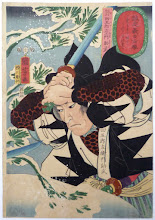
As a little teaser, here's a bit of flavor fiction I'm including in the game, along with art of the character involved, Xiao Shen, by Dylan Hartwell.


Xiao Shen lept across the temple courtyard, over a dozen fallen monks. The masked adversary awaited the attack of the final Jade Fist standing. “How could one man defeat all of the martial monks by himself?” she wondered. His kung fu was impressive and had easily countered all of the Jade Fists' techniques. But Xiao Shen also had a few tricks up her sleeve.
Just before Xiao executed her Golden Palm Strike, the adversary switched to a Winter Lotus Stance and used Xiao's momentum to hurl her over his shoulder and sent her flying into the main hall.
“No Jade Fist can stand against the techniques contained in the Dark Phoenix Manuscript. Not even you, Xiao Shen,” the stranger laughed.
Xiao burst back through the bamboo wall and hurled a blast of her focused chi energy at the assassin. The energy struck his head, sending the mask flying. Behind was a handsome face Xiao had known since childhood. The man leered at the young woman and struck the earth with his fist, sending pieces of flagstone flying in all directions.
“Elder Brother!” Xiao Shen cried, dodging the flying debris. “Not you!”

Wednesday, September 21, 2011

Micro-Review of a Micro-Game: Out of Time

JB of BX Blackrazor has released a one-page RPG based on the "Land of the Lost" type setting where temporal rifts strand folks from various times in a prehistoric wilderness.  The idea is to survive long enough to find a way home.

Here's his post, and the download link is in it.

My brief thoughts on this brief game?  It looks fun.  It's the kind of game I'd love to just pull out at a bar, along with some dice and a deck of cards (lots of d6's and a standard playing card deck with jokers).  Who doesn't like lost world settings?  Time travel is cool.  Getting to play a Sengoku samurai palling around with a Norse viking and Al Capone's lowest ranking hitman and his Tommy gun?  And running away from T-Rexes together?  Again, what's not to like?

Being a one-page RPG (with plans for future expansion?), the rules are brief and have one basic resolution system involving rolling X dice and trying to get Y successes (4 or better on d6 is a success).  Your stats are determined by randomly dealing playing cards.  Each suit grants abilities in one of four skill areas, and it's up to players to make their attempts to solve any problems relevant to the skill area they wish to use.  The other cool thing is that cards can be traded for automatic successes, or damage reduction.  So there's the trade-off of needing to succeed now, but making success potentially harder in the future.

I don't know if I'll be able to play it any time soon, but it's definitely something I'd like to try out.  I'm guessing it will be as fun as the other one-page RPG I tried out a while back, All Outta Bubblegum.

Monday, September 19, 2011

DC's New 52

Finally got a chance to check out a few of the new DC titles.  I read Justice League #1, Detective Comics #1, Action Comics #1, and Green Arrow #1.

JL1 was interesting enough.  Nothing super spectacular, though.

DC1 seemed like a fairly typical Batman story.  Decent, but nothing unexpected.

AC1 had a good setup for the story, and we appear to have a lower-powered Superman (for now), but what's up with the short sleeves and jeans uniform?

GA1 was more than a bit cliche.  Not impressed.

Any recommendations for other titles I should try out?  I've always been more of a Marvel than DC fan, but I figure this is as good a time as any to read more DC (and I haven't really read any comics for over a decade).

Sunday, September 18, 2011

Dungeon Design: AD&D 1E

So to continue this little series [part 1, part 2], I'm next looking at the AD&D 1E DMG.

The bulk of advice for crafting a campaign (not necessarily a dungeon) is from pages 90 to 96.  We get sections on placement of monsters, monetary treasure, magical treasure, and a bit later a sample dungeon (with map).

By this time, Gygax had moved away from the megadungeon-based campaign.  The advice he gives applies to both the dungeon (he still assumes the presence of one, it's just not assumed to be the only starting point for adventure) and the wilderness.  His monster placement advice is to try to keep things as logical and connected as possible.  The vast majority of monsters should have some rhyme and reason for being there.  And there's a very strong Law/Chaos war vibe as he stresses how adventurers tend to clear terrain of monsters, who usually don't come back, creating more peaceful settled lands -- until the monsters get forced out of the wilderness into the borderlands and peaceful settled lands beyond...

For treasure placement, both of monetary value and magical, he stresses both moderation, and challenge with the treasure.  Don't just have a big pile of gold lying around the goblin's den.  Give them a big locked, trapped chest of coppers that are a logistical challenge to return to town.  Convert coins rolled on treasure tables into trade goods that might be overlooked.  Make sure magic items are rare, well guarded, and if possible used against the PCs before they acquire them.

The sample dungeon map is serviceable, but to me at least not so inspiring.  The Holmes map, with its secret ocean harbor caves, mage's tower basement, rat warrens, and all seems more alive than DMG p. 95.  And he only gives a sample key for the first three numbered areas.

So there's not really much advice about creating a dungeon itself.

Aha, but then we have the Appendices!

Appendix A gives us the random dungeon generator.  Even if you don't roll the dice, it's still got lots of good lists for types and sizes of rooms, corridors, caverns, and what not.  It also tells us that 60% (12 in 20) rooms should be empty, 10% should have monsters with no treasure, 15% should be monsters with treasure, 5% specials (or stairs if there are too many specials in the area), 5% tricks/traps, and 5% unguarded treasure.  That's a lot more monsters and a lot less traps and specials than OD&D/Classic D&D.  It's nearly twice as many empty rooms as well.

Later, Appendices G: Traps, H: Tricks, and I: Dungeon Dressing give us some more ideas for fleshing out a dungeon.

We've got a lot less nuts and bolts advice for crafting a dungeon here, but there's plenty of good advice for adding details and life to the setting.  A lot of people I know started with one or another Basic set, then 'graduated' to AD&D, so they likely had a good idea about general dungeon design from there.  But people who only played AD&D might not have.  AD&D, at least by the book, seems more geared for wilderness gaming, where you go look for monster lairs in the wilds, rather than being focused on the dungeon.  But even then, there's not a whole lot of straight-forward advice on crafting those lairs as a challenge in and of themselves.  There's just generally more of a 'go get the monsters' tone than that of 'go out and explore.'

Friday, September 16, 2011

Dungeon Design: Holmes D&D

In the 1978 Dungeons & Dragons Basic Set, edited by Dr. J. Eric Holmes, the dungeon design advice of OD&D is pretty truncated.  It's mostly the same advice, but it's so condensed that it could be easier to miss.

However, Holmes did include a much more detailed sample dungeon, and a more evocative megadungeon cross-section than OD&D.  Also, the Basic Set came with either B1 In Search of the Unknown, or B2 Keep on the Borderlands, which both provide good examples for budding DMs to use to craft their own dungeons.

One bit of advice from Holmes that jumped out at me was this quote:

Try to keep the dangers appropriate to the levels of the characters and the skill of your players. (emphasis added)
While I mentioned that in OD&D Gygax points out that there are certain types of encounters that would make players angry, Holmes explicitly states that the goal is to challenge the players.  New players with 5th level characters will likely be less effective than veteran players with 1st level characters, despite the additional hit points, better hit probabilities and saving throws, and more spells of the novice group.  Because the veteran players will play smart.  And maybe they can take on those Frost Giants or Vampires or Purple Worms at the 1st to 3rd level span of the Holmes edition.

A few weeks ago, Ian at Magician's Manse was blogging about his own megadungeon.  His players seem intent to fully explore the first level before venturing on.  He was worried that if they did, they'd be too high level and the second dungeon level would be too easy for them.  It made me think of some of the advice given on Dragonsfoot and other places about only designing and keying just enough of the dungeon.  That way, you can fit the dungeon to the players, rather than to some ideal of the Platonic Megadungeon.

If the party gains character levels but doesn't descend to lower dungeon levels, then more monsters and traps of their level should show up on the level they're on.  Of course, tricks and traps and specials are often less about the party's level, and more about player skill anyway, so Dr. Holmes' advice above is a good addition to the basics set forth for dungeon creation in OD&D.

And so ends the 500th post on this blog.  And there was much rejoicing. (Yea...)

Wednesday, September 14, 2011

Dungeon Design: OD&D

I just skimmed through the first section of OD&D's Volume 3: The Underworld and Wilderness Encounters.  Having started playing D&D with Mentzer, a lot of the information was actually pretty familiar to me.  that's why it only got a skim.  I'm probably missing a few important points, but for the most part, Gygax and Arneson had figured out a lot of good advice for creation of a dungeon.

  • Make sure the place itself is interesting to explore.
  • Don't overcrowd it.
  • Allow for discovery, and re-use.
  • Keep monsters mostly appropriate for the level.
  • Place important monsters and treasures first, then if the place is too big, use random stocking to fill out the rest.*

Of course, Gygax assumes creation of a Megadungeon, similar to his Castle Greyhawk.  By the time Mentzer was re-editing the Moldvay/Cook edit, more thought went into creation of smaller dungeons with specific purposes.  But all of the above main points were still there.  There's not a lot of actual advice for the crafting of the dungeon, other than the sample map and semi-explained key, and the example of play, though. 

I do like the fact that in the sample dungeon, there's a 'special' which he notes is basically a Dick DM move to use, so don't use it.

Interesting differences from the later Classic D&D game include (old news to some of you, of course):

2 moves per Turn while exploring.  I guess this was taken from Chainmail, with its split moves each turn to allow for reconsideration/reactions.  240' (120' encumbered) per 10 minute Turn is still really slow, but better than in the later editions.

Doubled chances to find secret doors when searching.  Elves 1-4 in 6 (1-2 in 6 innate, rolled by the DM in secret), 1-2 in 6 for everyone else.


*I'm guessing that this picture of Gary's notes for Castle Greyhawk are so sparse because it's just the specials only.  The rest he was able to simply roll randomly as he ran the game.  Or maybe not even roll by the time this picture was taken.