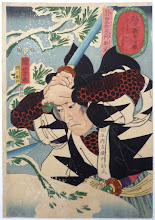
Just updating folks. I took my son ice skating last Tuesday. Fell and broke my arm. Typing with my left hand on my phone is annoying, but wanted to let folks know.
I need to order the final proof of Chanbara. Tried from my phone but the website won't let me. Hopefully I'll be released tomorrow and get it ordered from home. Then I can finally get Chanbara for sale in print!
Also need to get the next "why should I buy Chanbara" post finished.
Sunday, March 4, 2018


Friday, February 16, 2018
Why You Should Buy Chanbara part 1: How It's Different
I'd like to lay out
my reasoning for creating Chanbara, explain a bit about the design
process, and show what I did differently from other games that I
think will make this game worthwhile for you. I hate 'marketing
speak' and I tend to be too honest at times which makes me terrible
at sales. Still, I think I'm not just blowing my own horn here, and I
am proud of this little game of mine, so I'm just going to lay out
what I'm proud of and hopefully that will be enough to excite your
interest.
Shortly after
Flying Swordsmen came out, I thought about making a companion game
for a feudal fantasy Japan setting to go with the fantasy Golden Age
China setting of FS. At first, I thought I'd just stick to the Flying
Swordsmen system, just with a few different class profile options and
a different roster of monsters and spells. And I tried that, but it
didn't work so well. To be honest, I had limited myself when making
Flying Swordsmen since it was a retro-clone of Dragon Fist. But I
quickly realized that a pure a la carte special ability system like
in FS wouldn't work well in a game with stronger divisions in what
samurai, ninja and the various spellcaster types should do in the
game.
The next version
had twelve classes arranged in a triangle pattern of
combat/trickery/magic abilties. There were demi-human classes with
evenly divided abilities (tengu was fighter/mage, kappa was
fighter/ninja, and kitsune was nina/mage), one class that was pure
(samurai was pure warrior, ninja was pure sneak, yamabushi was pure
mage) and a class that was primarily X with a bit of Y (sohei was
warrior with a bit of magician, kensei was warrior with a bit of
sneak, etc.). There were three separate lists of special abilities,
and different types of spells, and... It was a mess. And confusing.
The early play test was fun, but I spent a lot more time than I
wanted trying to explain things.
So the final
version I tried to make as simple as possible. I went back to the
idea of a base class with profiles from Flying Swordsmen, with three
classes: Bushi (warrior), Shinobi (spy) and Mahotsukai (magician).
The demi-humans (with the addition of the tanuki) were relegated to
an appendix as optional. Instead of an a la carte list of special
abilities divided into power levels, every few levels you get a
choice of two special abilities for your profile [which leaves room
for myself or others to create more options for each profile in the
game]. With the divorce of the idea that profiles needed to partly
overlap with other class type abilities (it's still there a little
bit), I was able to come up with some different ideas that fit the
genre. I'll talk about the classes and profiles, and the inspiration
behind each archetype, in another post.
Figuring out the
character class options was hard. I figured that would be the hardest
part of the game. But it wasn't. Flying Swordsmen has a stunt die
mechanic (inheritted from Dragon Fist) where the die size is
determined by your ability scores, and increases as you level. You
can roll one every round of combat and they have several effects.
It's fun and chaotic and works well for Wuxia gaming...but for a
chanbara-themed game, it's not what I wanted. I tried several
different dice mechanics. I tried having each character (and the
monsters) have dice for fighting, magic and stealth/trickery, at
different die sizes by class specialty. I tried having decreasing
dice (if your Might [strength] die is d8, after you use it once it
becomes a d6, and so on). It was also a pain to keep track of.
Finally, I decided to simplify the dice. Bushi (warriors) get Combat
dice. Mahotsukai (magicians) get Magic dice. Shinobi (spies) get
Skill dice. Each character gets a pool of these dice to spend each
game day, and many of the profile abilities are dependent on using
one. It worked really well in play, and is similar to the 5E Battle
Master Fighter's Superiority Dice.
And even harder
than the bonus dice mechanic was figuring out how to motivate the
players to actually play according to genre tropes. Of course,
classic D&D works because the motivation is in the XP system.
Kill monsters, get XP to level up. Collect treasure, get XP to level
up. It took me a while, but I eventually came up with the Allegiance
System. All characters will have some allegiances. They can be to the
character's family, lord, temple, gang, teacher, trade union, etc. As
long as it's an NPC individual or organization, it's fine. Having
allegiances ties the characters into the game world. It helps you as
a player define your character. As a DM, it helps you flesh out your
game world. It allows for conflicting motivations (your lord wants
you to eliminate a distant clan member, but your clan of course does
not!). But that wasn't enough. I needed a way to tie it to XP,
because it's really XP that motivates players.
Eventually, based
on some insightful posts on Japanese fantasy by my friend Ted at his
blog, I got the idea that I should keep XP for defeating (not
necessarily killing) enemies as in D&D, and use a variation of
the 'carousing' rules used by many OSR bloggers. Characters in
Chanbara only gain XP from treasure if it's donated to a liege.
There's also a third way to gain XP, by playing to genre tropes of
choosing humane actions over duty. Since many gamers may find the
concepts hard to gauge, I recommend in the book that the group
nominate players for this kind of XP bonus, and the group vote if it
should be awarded or not. It's a bit story-gamish, and fuzzy, but I
think the game will play just fine if players don't worry about this
third type of XP (or if the DM just hands it out when he/she feels
it's justified). Anyway, the idea that you can advance faster by
serving your lieges' interests (along with advice to the DM to use
liege conflicts to good effect to inspire difficult choices) makes
the game stronger. It's definitely better than the 1E OA Honor
System, which is pretty much a straight jacket for roleplay, or 3E OA
with advancement based only on combat.
So to sum up, I
think Chanbara is different from other Asian fantasy games mainly in
its use of the Allegiance System tied to XP advancement. Its
selection of classes and special abilities, including the special
bonus dice system, is also fun and helps set the game apart from
other OSR games.
Thursday, February 8, 2018
Get your game on with Chanbara!
I've just put the ebook version of Chanbara up for sale on DriveThruRPG. Here's the link:
Chanbara

The print version proof is on the way, but I may have mentioned that post from the States to Korea has gotten really slow over the past year or so. It used to be about a week for packages to arrive. Now, possibly due to increased volume (Korean re-shippers allow Koreans to order all sorts of stuff from American Ebay, Amazon, etc. that normally doesn't ship overseas) through Korean Customs, it takes about a month. Hopefully it will arrive sooner rather than later.
Here's the rundown on what you'll get if you choose to purchase:
Chanbara
A Role Playing Game
Demons whisper in the sleeping ears of influential ministers. Ogres and spirits harass villagers that wander too far into the mountains. Ghosts haunt ruined castles and forgotten temples. Rebellious daimyo scheme to usurp the Shogunate. Heroes are needed to protect the Jade Islands from the supernatural threats that are on the rise.
In Chanbara, players take on roles such as stoic samurai, stealthy ninja, or idiosyncratic yamabushi. In addition to battling monsters, spirits and demons, these heroes need to balance the various obligations and duties to clan, lord and society in a regimented culture. Being selected to battle the forces of evil does not excuse one from obligations or strictures of honor and duty.
Chanbara plays like traditional fantasy role playing games. Players control characters who explore dangerous locations and battle monsters and bring back the treasures they hoard. Unlike other games where characters amass wealth in order to purchase magic items, build strongholds or else carouse away their winnings before adventuring again, in Chanbara the characters are not gathering the treasures for themselves. They turn over the wealth they acquire to their lord, clan, temple, or some other cause they serve in order to advance their interests. By doing so, they gain status, fame, and positions of power.
Chanbara is an OSR style RPG based on Japanese fantasy tropes. In 64 pages you get a complete RPG for dungeon, wilderness, and urban adventures.
The book includes rules for:
- Character Creation featuring the six ability scores and other stats you're familiar with from the world's most popular RPG.
- Three character classes, each with three or four subclasses.
- Bushi (Warriors) can specialize as Abarenbo (Rowdies), Kensei (Weapon Masters), Samurai (Warrior-Aristocrats) or Sohei (Warrior-Monks)
- Mahotsukai (Magicians) can specialize as Onmyoji (Exorcists), Soryo (Priests), or Yamabushi (Ascetics)
- Shinobi (Spies) can specialize as Kagemusha (Shadow-Warriors), Ninja (Secret Agents), Taijutsuka (Martial Artists), or Uragata (Infiltrators)
- Social Class: Four (or Five) social classes provide a list of possible background skills, plus benefits and hindrances based on social status.
- Background Skills based on a simple 2d6 system which meshes with class abilities.
- Equipment Lists covering weapons, armor, adventuring gear, typical services, hirelings, and special shinobi gear.
- 126 Spells, some familiar, some brand new, from level 1 to 6 for each mahotsukai subclass.
- Exploration, Interaction and Combat rules, including rules for running positions of authority or holdings as well as dungeon and wilderness encounter tables.
- A thematic system of character advancement tied to challenges overcome, support for one's allegiances, and just actions that give the game a unique feel while still retaining what makes fantasy adventure gaming fun.
- Over 100 Monsters including a dozen NPC types and 44 normal animal types, the rest pulled from Japanese legends and myths.
- Treasure Tables, including a DIY magic item generation system and sample magic items.
- Appendices including non-human races, conversion notes for other OSR games, a list of inspirational media, quick reference charts, and a character sheet.
Did I mention that all this fits in only 64 pages? And there's plenty of evocative art from actual Japanese artists whose work is now in the public domain.
Print Version: a 64 page softback with color interior artwork. (Available after inspection of proof. Coming Soon!)
Ebook Version: a 65 page (including cover pages) PDF with hyperlinks in the TOC, Index, spell list (by level), and internal rule references ("see p. XX for more").
Tuesday, February 6, 2018
Gaming Inspiration from Artemis by Andy Weir
My mom sent me a copy of Andy Weir's sophomore novel Artemis as a Christmas present, and I read it a few weeks ago. It's a pretty decent book, telling the story of Jazz Bashara, a porter and smuggler living in the first city on the Moon. She gets involved in a corporate espionage plot to leverage existing lunar resources for a mysterious new technology, but the lunar resources are currently controlled by some ruthless folks...
I don't want to spoil the plot. It was pretty good. It made me laugh in parts, and had some pretty exciting scenes, some interesting intrigue, and some solid scientific backing for things going on. I'd say it wasn't quite as good as Weir's debut book The Martian, but it was solid. [For comparison, I read The Martian and Ready Player One back to back, and enjoyed both but liked RPO a bit more. I'd say I enjoyed Artemis a lot more than Armada, the follow up from RPO's author Ernest Cline.]
A few things in Artemis made me think that they'd be useful to think about the next time I run a sci-fi game that's not already in an established setting (or something like Star Frontiers where only the briefest details are given and left for the GM to flesh out).
The lunar city can't mint their own currency, but they use 'slugs' or soft-landed grams. Want stuff shipped to the moon? You've got an allowance in weight from the company every month. You can trade your weight allowances to others. Hence it's a de facto currency. I also recently read Joe Haldeman's The Forever War (yes, I should have read it years ago...I've got a long list of books I 'should have read years ago' and I'm making progress on them) in which the war caused massive food shortages, rationing, etc. and the world currency becomes Calories.
Sci Fi games tend to use generic 'credits' as money in the game, but next game I run the 'credits' will be backed by something the way they are in these two books. It should add a bit to the immersion in the setting, and also hopefully give the players ideas for creative solutions and myself ideas for creative problems in the game.
The next thing is that Artemis really drilled home how hazardous it can be to go around in EVA suits. (Of course in The Forever War the combat suits they wore had many of the same problems at first, but as technology advances in that book which takes place over centuries, many of them get fixed.) In a space age but not radically advanced sci fi setting, just climbing over rocks in a pressure suit can be risking your life. Leaks are hard to stop, and suits can get damaged easily, and the vacuum of space will show you no mercy. It's no wonder that most sci fi stories take place on what Star Trek considers 'class M' planets or on the ships. Next game, if it's not super-advanced tech level (or even if it is), I need to remember that a moon, asteroid, or planet with no atmosphere can be a challenge without ever needing to break down into combat. Poisonous atmospheres as well, although that's maybe a bit easier to deal with than vacuum.
Monday, January 29, 2018
Chanbara is in Production
Well, I have the print proof of Chanbara ordered from DriveThruRPG. It should be a while (one to two months) to get here because of international shipping, though.
As far as the PDF version, goes, though, I'm having trouble. The PDF file looks great when I export it (I'm using Scribus 1.5.3) but the bookmarks don't appear in the tab. And I can't find any useful advice to fix the problem on the web.
So I have a choice to either delay the ebook release, or release it without that useful function. Aggravating!
But at least you all can rest assured that Chanbara is NOT vaporware.
I'll keep you all updated, and also try to get a few gaming related posts up soon. I'm finally getting a bit of actual vacation this week so I'll try to spend a few hours blogging.
Thursday, January 18, 2018
Chanbara is nearly there!
I finished layout the other day. I was busy with real world stuff, but two nights ago I printed up a copy before I went to bed. Now I'm going through the draft with a fine-toothed comb looking for mistakes. And there are plenty! I think I've got the cover sorted out.
Once I get through the manuscript hard copy and fix the mistakes, I'll put the files up and order a printed copy proof. Then I'll add hyperlinks to the file for the ebook version and once that's done I'll put it up for sale.
I'm kinda excited about releasing my first game book for sale. Hopefully it gets as good a reaction as Flying Swordsmen got. Fingers crossed, I'll have the ebook version out next week. Due to overseas shipping to Korea taking much longer than it used to, it will be a bit longer for the physical book to go on sale. But it's going to be out soon.
Now I need to get started on the monster book and converting my playtest materials into modules!
Monday, January 8, 2018
Primary Layout of Chanbara is Complete
Sorry for the string of boring posts lately. I'm pretty busy these days, and I don't have much in the way of game theorizing or speculation to offer up at the moment.
I would like to let people know that just after lunch today, I finished my primary layout of Chanbara. I will print it up and look over a hard copy to examine it for errors. Then I need to design the cover (it will be pretty simple, a minimalist Zen aesthetic should work). Once that's done, I'll upload it to OneBookShelf and send off for a print proof. I'll also insert hyperlinks into the ebook version and then offer it up for sale.
I'm teaching an intensive (like nearly non-stop classes) English camp starting tomorrow until next Sunday, so that will slow things down a bit. I did the camp last summer, and it left me pretty exhausted every day. But I don't expect it will be much longer before I release Chanbara to the public.

Subscribe to:
Posts (Atom)